88º ~ hot, hot, hot with humidity that rises throughout the day, bright sun with a chance of storms that I do not believe, as they've avoided our neighborhood for so long
I picked up Jessica Baran's Equivalents (Lost Roads 2013) on a whim at AWP, in part because of the book design. It is a hand-pleasing square, 6.5" x 6.5". I also picked it up because Baran won the first Besmilr Brigham Women Writers Award, which champions work by female poets who live outside the literary centers on the coasts. In fact, the deadline for 2013 submissions is just a week away. While I haven't submitted, after reading Baran's book, I'm inclined to do so.
The notes at the back of the book tell us that Baran takes the title of the collection from the work of Alfred Steiglitz, specifically his set of photographs of the sky, taken from 1925 - 1934. The collection is divided into three sections, where each section has a title but the poems within are numbered rather than named. We have "On Dailiness," "On Dissonance," and "The Panorama." The first two sections contain lyric prose poems, while the third contain poems with traditional line breaks. The first two sections contain philosophical musings about the modern world (think technology / white noise versus nature / enough calm to contemplate), while the third is a reflection on John J. Egan's panoramic painting of the Mississippi River housed in the Saint Louis Art Museum, containing many of the themes of the first two sections as well.
As I sank into Baran's syntax (sometimes sparse and fragmented, sometimes prone to catalogs and lists), I kept coming back to the movie, Koyaanisqatsi (1982), the title of which is a Hopi word for "life out of balance." The film contains no plot and no dialogue, but is a series of scenes exploring the consequences of modern technology on the natural world and on our society / lifestyle.
Baran's themes run in similar veins, without, perhaps, the clear call to action as in the film, and her poems are definitely not plot driven, instead piling images and aphorisms one after the other until we are weighted down with contemplation. She uses the language of commerce, capitalism, and politics, interwoven with the language of artifice, photography, and film. For example, the first poem in the book opens with this:
I'm not interested in propaganda. The space where you arrived is empty when you leave. The lake is open to questioning. Everyone has a different method: of lending, of accruing debt. Water can be boiled in all sorts of weather, but the pot cannot be outsourced.
Everywhere in the poems, we are reminded of the artifice of modern life. The poet is clearly looking at the world through a specific lens, a lens that may be adjusted or exchanged for another, shifting views and ultimately shifting truths. Nothing is stable, and we are all facing that gigantic, empty sky of Steiglitz' photographs, which come to symbolize the greater void in living a life out of balance.
Baran's first section, "On Dailiness," is probably my favorite, as it contains many comments on domesticity (and therefore often comments on the female). In poem number four from this section, she highlights our disconnected nature, a disconnection that began way back when groups of humans gathered into societies and started "taming" the wilderness in order to live. After describing sheets, sofas, a bed comforter and other daily items of housekeeping, Baran continues:
An anthem to dailiness. An American history of lost civility; the decline of small gestures. ... Is this the clearing you were looking for? It's not what you expected: not the rich black burnt thatch long lost woodsmen cleared in a wood of pines. Not the tractor-flattened part of the meal-colored prairie. Just a carpet sample thrown on faux terrazzo tiles.
In these poems, we are confronted with a town crier whose words bounce around a cluttered, over-stimulated town square, and we ultimately fear / know that no one is listening as we hear proclamations that "consumption levels are off," "decades collapse," and "[i]ndustry encroaches on nature--a great Modernist trope." Meanwhile, we must all "self-curate or vanish" as "[i]t's never easy getting words to work" and "[p]lace doesn't matter any more."
While all of this may seem heavy, political, and heart-crushing, it is also comforting to know that there are others out there observing and commenting on the cacophony of 21st century, American life. It is the job of poetry to slow us down, to open us up to the clutter and the void, and to lead us on, wherever the journey takes us. At this, Baran excels.
Saturday, June 22, 2013


Wednesday, June 19, 2013
What I'm Reading: Small Porcelain Head
85º ~ as promised we have waves of high temps with humidity-induced "feels like" in the 100s and then days of respite, sadly we've missed much of the rain that peppered the state over the last few days, had to water the front garden today
While drafting, revising, and submitting sputter along at agonizing paces, I'm returning to my reading goal. Today, I've read Allison Benis White's Small Porcelain Head (Four Way Books, 2013) twice. Yes, that's right, twice. Allison and I have an AWP friendship, cemented by a pedi-cab ride in Denver, and while we do not correspond regularly, I am always thrilled to see her smile, which reaches right up to a sparkle in her eyes, whenever we cross paths amidst the sea of other writers at AWP.
Small Porcelain Head was on my to-buy list in Boston this year, and here I am, finally, giving it the time it deserves. I read the book twice because each poem is an intense, fragmented, short, lyric prose poem, and from the first page, I was gripped with a sense of tragedy and urgency, an undertow of violence against the female body, that lead me in a rush, headlong through the book. (If you favor a clear narrative with much explanation and abundant details, this is probably not the book for you; however, I found the fragments and sparseness intensely powerful.) On the second read, I made myself slow down and absorb each poem.
Here's how Allison creates that sense of urgency and dark tragedy. Many of the poems feature fragments of if, then, therefore arguments. We are so used to these statements that we keep moving forward, looking for the logical conclusion, which doesn't arrive, except as a general thematic wholeness after the entire book has been consumed. By fragmenting the logic, the reader is often left without any solid footing, which is the same predicament of the speaker of the book (sometimes a girl or woman with a doll, sometimes the doll itself). For example, the first poem in the book (all poems are untitled and the table of contents lists the first phrase of each in lieu of such), is made up entirely of two "if" statements without any "then" or "therefore."
If pain is only weakness leaving the body,
black curls, still wet, painted on her fore-
head.
If pain is a desire for dark shapes, even
when dried, glistening, if you are reading
this.
The title of the collection is vital to creating a context for the poems, and throughout the book, we read about, or from the view of, such diverse dolls as porcelain, wax, tin, cloth, conjoined, and paper. We confront dolls with strings and keys used to "animate" them. Often the dolls are damaged in some way, heads pulled from bodies, wax faces melted, bodies hollowed out or torn open, hands or feet broken off and missing, etc. Often, we are reminded of how the dolls' bodies have been manipulated, especially regarding those that come with a pull-string that activates the voice.
Throughout it all, there seems to be a human speaker attempting to navigate a great loss, a grief too large for comprehension, and that speaker questions the worth of going on with living. In one poem, the speaker states, "Love for the world ... is ruin." And in another, she refers to a doll that speaks when her stomach is pressed down, stating:
No, she is mute as the moments I accept
God or make a voice from objects, pressing
her stomach, pressing her stomach, not
screaming.
Without being stated directly, I found themes of pregnancy and motherhood, and most thoroughly, the female body as object, manipulated by both outside forces and internal pressures. After describing a doll with her arms raised and a turnkey in her head that creates a moaning, the speaker states:
After a while, we moan and lift our arms
in order to feel what she feels: her pose is
agony.
As I sit here, flipping through the collection one more time, I'm stunned by what Allison has created with so few words. This is definitely a set of poems that should be read all together, and I think in order, to gather their true force. These poems also highlight both concision and diction, as each word bears a tremendous weight. While they might be prose poems, there is something of Emily Dickinson here that lures me in via the fragment and the condensed yet fraught imagery. As I contemplate re-reading the book in the future, I imagine much more will rise to the surface, reminding me of both philosophy and the best of poetry.
Thursday, June 13, 2013
What I'm Reading: Wild
85º ~ heat and humidity simmering before 9:00 a.m. on the way up to a heat index of 110º, oh joy!
Here's a rare post on a prose book, Cheryl Strayed's Wild: From Lost to Found on the Pacific Crest Trail. While the book does chronicle Strayed's hike along the PCT, at its core, this is a book about weathering profound grief. In Strayed's case, that grief revolves around the death of her mother, who was in her mid-forties when she died of lung cancer. Strayed was in her senior year of college when her mother died.
I'd heard numerous interviews with Strayed on NPR and read lots of positive comments on blogs and social media before I opened the book. I was surprised, though, at the connection I felt almost instantly. Strayed grew up in Minnesota and graduated from high school just a few years before me. For a few years, we were both in the same state, both going to colleges only a hundred miles apart. She's the age of my sister, and when I look at her author photo of her blonde hair/blue eyes, I realize I went to college with any number of girls who might have appeared just like her. More importantly, she knew she was a writer even in college, just as I did, although it took her awhile to work out the kinks and become a writer, just as it did for me.
With deep honesty, Strayed details her downward spiral after the death of her mother, including her use of sex and drugs at the period in her life as a way to try to make her way, motherless, in this world. As she hits rock bottom, she decides to make a drastic life change by heading west to hike the PCT. She is completely unprepared and inexperienced and spends much of the book learning by doing (which often left me feeling anxious and stressed for her). Throughout the book, Strayed displays an incredible ability to remain self-aware and willing to share that self-awareness with true honesty. She pulls no punches with herself or with the reader. She lays herself bare both physically and emotionally, and through that action, she comes to terms with the death of her mother and with what she is making as a kind of life.
Here are the parts of the book that jumped out at me, with page numbers from the 2012, Vintage paperback.
51
"Fear, to a great extent, is born of a story we tell ourselves, and so I chose to tell myself a different story from the one women are told. I decided I was safe. I was strong. I was brave. Nothing could vanquish me. Insisting on this story was a form of mind control, but for the most part, it worked. Every time I heard a sound of unknown origin or felt something horrible cohering in my imagination, I pushed it away. I simply did not let myself become afraid. Fear begets fear. Power begets power. I willed myself to beget power. And it wasn't long before I actually wasn't afraid." (Strayed's italics)
60
The one book that Strayed carried the entire length of her hike and didn't burn as she read, to lighten her load, was Adrienne Rich's The Dream of a Common Language. At this point in the book, Strayed mentions the poem "Power." The poem features Marie Curie and ends:
She died a famous woman denying
her wounds
denying
her wounds came from the same source as her power.
100 describing her mother's incredible physical pain in her last days
"The way she begged for something that wasn't even mercy. For whatever it is that is less than mercy; for what we don't even have a word for."
111 describing what it was like as "the only girl in the woods, alone with a gang of men" and her trail-induced dirty/stinky body
"By necessity, out here on the trail, I felt I had to sexually neutralize the men I met by being, to the extent that was possible, one of them."
***this sentence lept out at me as a parallel to what women have been doing for decades in the workplace
141 regarding the drudgery of the trail and the endless steps that make up the hike & MATH!
"I walked on, a penitent to the trail, my progress distressingly slow." (Ultimately, this slowness is what heals Strayed, as it forces her to confront her grief in elemental ways.)
"In my perception, the world wasn't a graph or a formula or an equation. It was a story." (This describes Strayed's attempt to use her map and compass to navigate through the snow and how she never really took to math...uhm...DITTO! This quote sums up my relationship to the world as well and may explain why I'm terrible at telling distances, weights, and measurements of all kinds, but I can tell you the "relation" of things.)
209 describing the moment she loses her boot and how she expected someone to "come laughing from the woods...saying it had all been a joke."
"But no one laughed. No one would. The universe, I learned, was never, ever kidding. It would take whatever it wanted and it would never give it back."
Yes.
304 describing the Rich book and lines of poetry
"Often, I didn't know exactly what they meant, yet there was another way in which I knew their meaning entirely, as if it were all before me and yet out of my grasp, their meaning like a fish just beneath the surface of the water that I tried to catch with my bare hands--so close and present and belonging to me--until I reached for it and it flashed away."
Yes, Yes, Yes!
Tuesday, June 11, 2013
Would You Say I Have a Plethora?
88º ~ in the words of Glenn Frey, "the heat is on," a punishing sun, humidity low now, but on the rise, no breeze to speak of
So, there are two 80s references for you, dear readers. The first, in the post title, = The Three Amigos; the second = Beverly Hills Cop. If you are unfamiliar with these allusions, get thee to Netflix and get thee quick! Ahem, it seems I'm unable to write without ripping off others today (sorry to you, too, Shakespeare!).
Ok, I'm in a bit of a dither. I'm a bit disgusted with myself. I'm a bit out of control. Here's the issue; I pride myself on being super organized. When I've described my way of tracking submissions in the past, many of you have commented on just that organization. Well, today, I proved myself a bit of an idiot.
One of my summer goals was to rip up and reorganize into two chapbooks what has been circulating as manuscript #2. Now, that manuscript has been making the rounds FOR YEARS and has existed in so many iterations that I've lost count of the number of different ways it has been organized. However, somewhere in all of the reorganizations, I forgot to keep track of the poems I pulled from the manuscript and set aside. So, this morning as I was working on the remainder of the manuscript after taking out all of the fairy tale & saint poems earlier, I realized I had two more stacks: body poems and elegy/prairie poems. Then, it dawned on me that there was a body poem that wasn't in there, "Vespula Cures," published by the lovely folks at Connotation Press, lo these many years ago! When I went looking for that poem, holy crap!, I found nearly a dozen poems that were languishing in the purgatory of a "published poems" folder on my desktop but that hadn't made it to a manuscript, or had but had been removed st some point.
I pulled one thread and a whole sweater unraveled at my feet (one of my plethora...hee hee).
So, I've spent the last two hours, printing off copies of poems from 2010-2011 (pre-sickly speaker) that weren't included in any current manuscript. Then, I shuffled my new chapbook piles, and I do have the makings of three chapbooks: fairy tales/saints, body, and elegy/prairie.
So, this was a good chunk of work, but I'm kicking myself for how long this whole process of book publishing is (be it chapbook or spine-book) and how much I set myself back by losing track of perfectly good poems, poems that coalesce in a new way now that they are grouped in smaller portions.
This, then, is the work of poetry, stumbling blindly through the dark, going by instinct built on years of practice.
Onward! (Or, in other words, "Write, very old one, write like the wind!")
Monday, June 10, 2013
Draft Process: Had We Been Born Boys
82º ~ preparing to weather at least seven days in the high 90s with the heat index tipping toward 110, the humidity reaching "unbearable" stages, still from inside the house the sun and the breeze cheer me
Welcome back to a more positive outlook, dear reader. I did take the weekend off from poetry, spent it with Cheryl Strayed's Wild (though I still have the last section to read), the Chicago Cubs (1 for 3), housekeeping, and collaging. Still, as I read Strayed's intense memoir, I found myself jotting notes in my journal about the angry sisters. One of those notes prompted today's draft.
That note was the phrase "had we been born boys." While gender is not at the forefront of Strayed's story, which is about navigating the loss of her mother, the undercurrent is filled with gender, as Strayed remarks again and again how few women are also hiking the Pacific Coast Trail, and as she comes to terms with her own use of sex as a way through grief. Somewhere in the reading I thought of the angry sisters and how they wield the tools of their father (hammers, saws, axes, etc.) with ease, and how influenced they are by their father's view of women. (And here, some autobiography seeps in, as, yes, I am one of three daughters and no sons. Yet, I'm happy to say that the angry sisters have taken on a story of their own that deviates wildly from mine. For example, anyone who has ever seen me try to use a hammer would testify that I am a total klutz and unskilled at building/fixing things.)
At first, my draft began with the above phrase as the first line, but it quickly became apparent that the phrase would become the title of the draft. The rest of the poem is just 15 lines, three stanzas of five lines each, each line roughly eight syllables, give or take...I'm no formalist. This line and stanza length presented itself quickly and wholly in the first stanza, and then I had to tinker to get the next two to fit, but that tinkering helped me focus my images. The three stanzas imagine how the sisters' ease with their father's tools, the influence of his "stash of girly magazines," and their quest for vengeance would be different if they were born male.
My worry about this draft is that it all seems so completely obvious, a feminist cliche. Time will tell, and I have to remember Anne Lamott's encouragement of shitty first drafts!
Friday, June 7, 2013
Staying on Target: Writing Without Deadlines or Distractions
73º ~ they say the heat & humidity will arrive by Monday with temps in the upper 90s and humidity bringing the heat index up into the 100s; for the next 3 days, though, oh, the glorious late spring delirium remains, window thrown wide open in celebration
A scene from Star Wars.
A scene from Star Wars.
Gold Two: [the Y-wings are running the gauntlet toward the Death Star reactor-port] The guns - they've stopped!
Gold Five: [realizes why] Stabilize your rear deflectors... Watch for enemy fighters.
Gold Leader: They're coming in! Three marks at 2-10!
[Gold Two is slain by Darth Vader and his wingmen; Gold Leader starts to panic]
Gold Leader: It's no good, I can't maneuver!
Gold Five: Stay on target.
Gold Leader: *We're too close!*
Gold Five: Stay on target!
Gold Leader: [shouts] Loosen up!
[he too is picked off by Vader and Company; Gold Five tries to escape but is fatally winged]
Gold Five: Gold Five to Red leader, lost Tiree, lost Dutch.
Red Leader: I copy, Gold Leader.
Gold Five: It came from... behind!
[crashes]
The above is from the original Star Wars (1977), now known as Episode IV: A New Hope. I confess, I love science fiction, and although I don't read it nearly as much as I did when I was younger, I will forever be a Star Wars/Star Trek geek.
Why am I talking about this? Because as I was pondering what to write in this blog post and how to address the fragmented nature of my week, this scene popped into my head, along with the urgent, repeated "Stay on target." So, here's the scoop. This week, I've managed to revise and polish a handful of the angry sisters poems, and I've read a bit from Cheryl Strayed's incredible memoir, Wild, but I haven't written a new draft, and I haven't felt really good about my writing self. I've been getting the first set of rejections for the fever manuscript and I suppose that isn't helping.
Yes, I did get the A/C repaired, tackled an out of control backyard littered with sweetgum balls and in need of mowing, replaced the fried refrigerator, talked to the alarm company and got our system reset after the power surge knocked it offline for a bit, and now, I'm battling fleas! Our cats were up to date on their treatment and still the biting buggers got in (I suspect I brought them in from the out of control back yard, which is populated by an opossum, perhaps a raccoon from time to time, and an outdoor neighborhood cat...yes, we live in the CITY). Still, I'm not teaching, so tackling those tasks on top of laundry / dishes / vacuuming / etc., really doesn't mean I have NO time to write.
Yet, I am failing to stay on target in terms of my writing goals and I don't know how I feel about that. I do know I am my own worst critic, my own worst task master, etc. See, last year, I decided I would write a poem a day in June. I did this b/c the sickly speaker had gathered such momentum that I wanted to finish her story. This year, I don't feel that compulsion. The angry sisters poems are still floundering in the darkness.
Also, truth be told, I'm confused about pacing. I wrote all those poems for book #2, which has failed to be accepted in either contests or open reading periods (with 3 verdicts still out there but not looking good). I published a great majority of those poems in lit mags, and now many of those poems are five years old or more. I've read them at readings and heard back from folks who've read them online or in print. I'm beginning to feel disconnected from them. If and when they actually do appear in book form, will my connection to them return? Now, the sickly speaker is out there and many of those poems have appeared or are forthcoming. I've read them at readings here and there; I've gotten feedback from readers. And now, she's being rejected in book form as well.
What do you think about this? Just giving up on the idea of the book and publishing the individual poems in journals and letting that be that. So be it. Is that enough?
But back to today's post title (see I'm all over the place), what is my target for these long, undistracted days of summer when there are no clear deadlines, no papers needing graded, no students needing responses to their frantic emails, etc.? Am I a "bad" writer if I don't produce copious numbers of drafts this summer? Who is judging me? What would happen if I took a break from poetry? If I simply ignored my desk and made my way about my daily household chores and then watched hour after hour of mindless TV reruns while playing solitaire on my iPad? Would that make me a "bad" person?
For someone with perfectionism issues, the idea of staying on target is a double-edged sword. Yes, it drives me to "succeed" at the goals I set for myself, but it also makes it really hard to cut myself some slack when I "fail." (I may not be using those quotation marks correctly, but I'm trying to indicate those measurement words that mean something different to us all.) And the question at the center of it all: Just exactly who is it I'm trying to please?
If you are still with me here, thanks for staying on target (ahem...reading); I'm sure "this too shall pass." The goal of this blog is to be honest about the writing life, and this is the state of my writing brain at the moment.
Tuesday, June 4, 2013
Jello Wrestling, Or How a Draft Becomes a Poem
75º ~ the beauty of spring continues to linger into what is normally something like a hot summer already in early June, partly cloudy but no complaints, calm air, everything lush & green
I confess, I have never wrestled in Jello. I confess, I used that as the title to this post to get your attention. I suppose I could have said, "Catching a Greased Pig" as well. Still, there is something to be said of the analogy between wrestling and revision.
Again today, I turned to my "In Progress" folder and called up each of the drafts I've worked on since November. That's right, November. I truly don't believe there is a right or wrong number of days to wait before starting on revision, as long as there is some kind of waiting period to clear the mind. Some of the poems I've just worked on have been in the folder for six months; however, that is more of a result of my academic life & responsibilities than of any need to wait that long.
The waiting period is crucial, though, because it provides perspective. The first poem I worked on today was drafted on 14 November 2012. This poem is one of those that arrived with great energy, and I've continued to remember the opening stanza without really trying to memorize it. Based on the copies I have printed out, I worked on the poem again in January 2013, making a major change in point of view to the second half of the poem. All this time, as I've been haunted by that opening stanza, I've also known, I mean known, that something wasn't quite right about the poem, and yet I could see the potential. I knew what I wanted the poem to do (in an abstract way) but I hadn't figured out how to get it there.
Yesterday and today, I returned to it again, and something simply clicked. I had to cut away some lines I thought I loved in the second stanza and add something new there. I had to change the lineation in two or three places. As many of you know, I'm fond of indenting and creating white spaces; however, there is a craft to this as well, and while it might look like the poet has simply used the enter and tab keys willy-nilly, this is not the case.
To revise well, I have to have a little distance from the initial rush of the first draft so I can catch my breath. I have to be able to listen, really listen, as I read the draft aloud over and over, tinkering with the linebreaks and the word choice. The poem really does seem to know where it wants to go, but I have to be able to hear it.
And that, my friends, is the most frustrating thing to read or hear when you are trying to figure out how revision works. Still, after years of writing, I have to relearn this with every poem. At a certain point, the poem and I are wrestling with each other. We grapple with sounds and breath, and eventually, neither of us wins but through the struggle the poem is made.
I'm thrilled to say that I have six poems now, each in its own folder, that seem nearly ready to go out and meet the world. These will be the first six poems since I finished the sickly speaker series last fall. I'm hesitant, of course, but also eager to see what reaction they might receive.
Monday, June 3, 2013
A Little Chaos and A Sickly Speaker Poem up at Anti-
68º ~ some kind of blessing after the storms, a cool, cool day with very little humidity, tho lots of sun and a sweet, sweet breeze
A weekend trip to the in-laws culminated in returning home to find a wee bit of storm damage. This was the subtle kind of damage that didn't make itself apparent right away. No, instead, we surveyed the yard and the roofs and found all intact after Saturday's severe thunderstorms and strong winds. Only later did we learn we'd suffered the dreaded "surge" and our heating & A/C unit's "board" was blown, so no fan action. Also, our refrigerator was fried and something in our alarm system is messed up. All other major appliances intact, and the fridge was 10 years old. So, repairs and replacements are in the works.
In happier news, the new issue of Anti- is up, and it is stellar, simply stellar. I'm so happy that one of the sickly speaker poems makes an appearance. In fact, "The Alchemy of My Mortal Form" is one of the first of the poems from that series. You can read about the drafting process for this specific poem here.
Today, my plan is to sort through the current drafts of any angry sisters poems and see if I can revise & polish any of them into submittable form. I've got most of the sickly speaker poems that haven't already found a home circulating, and to tell the truth, I'd sort of forgotten the next step with the angry sisters. Their poems were simply gathering weight. Now, onward with the whittling and the tweaking.
Hope everyone has survived storm and fire and all our other current plagues in one piece.
Thursday, May 30, 2013
Blurbing
81º ~ a stronger breeze than yesterday, cloud cover, the chance of storms
Reader, today, I spent the morning at the desk by finishing my read-through of a manuscript for which I've been asked to craft a blurb and then crafting said blurb. I've written a handful of blurbs over the last couple of years, and it dawned on me today that nobody every talked to me about writing one. I've gone blindly forward, so I thought it might make a good blog discussion.
First, what do you all think of blurbs?
If I know a poet personally, I skip the blurbs. If I've read previous books by the poet, I skip the blurbs. If I've read a poet's poems in the journals and those poems inspired me to buy the book, I skip the blurbs. I don't live in a large enough city to support large selections of poetry at the bookstores, so I don't tend to browse the shelves, where reading blurbs might come in handy. Instead, I often use the blurbs to check my own reactions to a book I've just finished, especially if I'm having doubts about my own reading of the poems.
Lately, I have taken to glancing at the writers of the blurbs, as the blurbers are often from the same aesthetic as the writer of the book. For years when I was just starting out as a poet, I didn't understand the incredible diversity in poetry today; after all, we don't label and shelve books of poetry based on their approach, language poets on the bottom shelf, new-formalists on the top, narrative poets using the American vernacular stretched through the middle, etc. Lately, though, as I've built my personal library of poetry books and as I've read and read and read as widely as possible, I've come to know the groupings more by instinct and muscle memory than by any outward label. This can help me place a poet new to me before I open the pages, but it guarantees nothing about how I will receive the work.
So, what do you do if someone asks you to blurb?
First, I'd say only say "yes" if you can honestly say you like the work and feel a kinship for it. No, you don't have to be exactly the same kind of poet as the writer of the book, but a connection of some kind is necessary, lest the reader of the blurb feel fooled. When I was asking for blurbs, Mary Ann Samyn was so smart. She asked for a copy of the manuscript and the right to decline after she'd read the poems. (This is something I forgot until just this moment!)
Also, consider the time it takes to read a pre-publication manuscript and craft the blurb. Recently, I've had to decline some requests in order to focus on my own work.
In any case, once I've said yes and received the manuscript, I read through and take notes on the themes that pop to the surface. I'm old school and need to have the manuscript in hard copy, so I take my notes on the title page, which I've clipped together with all of the front and back matter. That way, I'm reading just the poems, undistracted. As I read, I turn over each page into a "read" pile on my left. When I come to a poem where I feel certain lines really speak to the major themes of the book, I underline and annotate on that poem. When I flip it over, I turn it crosswise to the rest. That way, when I've finished the whole stack, I have a dozen or so poems that I pull to re-read. These are the poems I use as references for my blurb, along with the notes I've taken on the title page.
In terms of logistics, if the publisher or poet has given me a word-length or other requirements, I keep those in mind as I start to draft. I keep it in present tense, like a good literary analysis instructor. Not everyone does, but I like to include at least one short quote in the blurb. For those people who use blurbs to make choices about what to buy/read, I think this is a great way to offer a snippet of the poet's voice.
Once I have a draft, I email it to the poet and ask for his/her feedback. I am completely open to any response, and I'm willing to scrap it and start over if the poet feels I've misrepresented the book in any way. After all, it's an honor to be asked to blurb and I wouldn't want to let the poet down. After the poet and I have settled on the draft, it goes to the publisher who may or may not want revisions (most often cutting due to space issues on the cover). Again, I'm willing to work out whatever is best for the book.
So, what are the benefits of blurbing? 1) I get to read the manuscript before almost anyone else. 2) I get to exercise those analytical skills that I don't use when writing poetry. 3) I get the free publicity of having my name on the back of someone else's book. And who knows? Perhaps, someone will read the book and my blurb and look up my work. 4) I get to give back and cheer on another poet.
Any blurbers out there with other thoughts on the topic? Feel free to leave a comment.
Wednesday, May 29, 2013
Submissions or Bust!
80º ~ seriously cannot believe how lucky we have been with the weather these past weeks, all sun, breezes, and green today, windows open, open, open!
Monday, I took the day off from reading/writing and spent time with C. We aren't really holiday type of people, so this meant going out to lunch and running a few errands. I ended the day with drinks with a good friend. Perfection.
Sadly, this all translated to yesterday being a total disaster work-wise. I couldn't concentrate on any one thing. I was fragmented. The time at the desk was near to torture, but I kept my BIC (butt in chair) and muddled through.
The pay off? Today was great. I already knew my goal when I sat down: Submissions or Bust! I did manage to get three submission packets put together and sent out to three journals. I've definitely scaled back on the number of poems I send out, and I'm okay with that. Slowly, slowly I've learned which journals are the best fit for me and which journals I really want to see my poems appear in. All that accrued knowledge means I'm more apt to shake off a journal I once might have submitted to because I now know my chances are slim to none, my work simply not matching the work of the journal. I'm also always open to submitting to a new journal if the mission statement/call for submissions seems to fit. I know a lot of folks like to re-submit to journals that have published them in the past, and I do some of that; however, I like the broadness of being in many different types of journals, scholarly & independent, online & in print, magazines & anthologies, etc.
After I ran out of steam on submissions, I turned to book #2, which has languished in semi-finalist, finalist, "great manuscript but we have to pass" purgatory. One of my missions for the summer is to split the manuscript into two chapbooks. This morning was my first pass. I approached it with this attitude: I'm not going to labor over this. I'm going on pure instinct. With that in mind, I flipped through the pages and pulled (yes, I have to use hard copy for this!) all the poems that fit the fairy tale & saints profile. Then, I did one more pass, asking myself if any others felt like they belonged with the tales. Now, I have two stacks of 20 and 30 poems each. Next, I'll re-read and re-order before creating new computer files. Luckily, I've already done a lot of research into chapbook publishers, so I should be ready to send soon.
As for the fever book (book #3), it's out there. I've sent it to a dozen publishers. Now, we wait. And wait. And wait.
And the angry sisters lurk, scuttle, and plot on the sidelines.
Sunday, May 26, 2013
Draft Process: Desecration Song
71º ~ a cloudy day, not unwelcome, keeping the heat at bay, tiny breezes, squirrels run amok
Last month I wrote about drafting several poems in response to a girl gone missing here in Arkansas. This past week, her body was recovered.
The angry sisters began in poems about an injustice done to them, personally. Now, they seem to be morphing into three angry women seeking justice for other girls & women. Are these political poems? Maybe. They are certainly responding to real events, although not naming those events.
Again, I have Traci Brimhall to thank for a draft. (I thank all the poetry gods & goddesses that Traci and I have become friends!) I keep coming back to Our Lady of the Ruins, in part because of the collective female speaker Traci uses in certain poems, and in part because Traci once told me that a poem of mine needed more ugly in it. I confess, I shy away from the ugly. I paint it over with pretty words, all the while trying to describe it. Somehow, the angry sisters are forcing me to face the ugly.
In particular, I thank Traci for her line, "Spring returns with its terrible resurrection," from "A Year Between Wars." I had already scribbled out a dozen clunky, long narrative lines about the discovery of the body last week. I really have nothing against great narrative poems; however, I am not at home there. I like the fragment and the white space, the hint and the leap. Still, these angry sisters sometimes drag me back to narrative. In any case, after setting my journal aside in disgust, I went back to Our Lady and discovered the line above. Instantly, I went back to the journal and wrote this:
At six o'clock we watch as spring
resurrects the bloated body of a lost girl.
No live footage. A map of the river.
The girl's familiar snapshot smile frozen
on the screen for months.
I continued to draft another twenty lines or so, realizing that my earlier draft paid too much attention to the girl...for the angry sisters, I mean. For them, the focus is always on "the sinner," the one who harms the girls or women the sisters seek to avenge (note: not always a man). In the journal draft, the sisters are angry because the man who killed this girl has already killed himself, so they can't do anything. In the journal draft, they build an effigy and destroy/burn it, my idea being that they would offer the ashes up at the girl's funeral.
Somehow, when I went from journal to computer, I remembered Traci urging me to get to the more ugly truth. The title of today's draft, "Desecration Song," may hint at what the sisters ended up doing in the computer draft...yep, digging up "the sinner" and tearing apart his actual remains. They then douse him in kerosene and light him on fire. The funeral of the girl never comes into it. Instead, the draft ends, "Our punishment is knowing we will always be / too late to play the role of saving graces."
I have no idea if this draft will survive in this shape and form. Time and revision will tell.
Saturday, May 25, 2013
What I'm Reading: Little Black Daydream
75º ~ a slight rising in temps, but still amazingly pleasant for the end of May, bright sun, cool breezes, last weekend's new plants settling in nicely out front
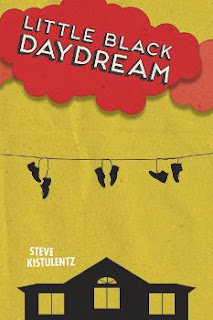
Steve Kistulentz' second book, Little Black Daydream (Akron 2013), is a book filled with American Cold War babies grown into speakers filled with both nostalgia for what was never an innocent childhood and anger, seething beneath the surface, that all the promises of a glorious future failed.
If you recall, I met Steve at the Arkansas Literary Festival last month (although it seems ages ago now). At that reading, I learned that Steve grew up in the shadow of Washington D.C., immersed in the world of politics. While there are only one or two poems in Little Black Daydream that feel at all confessional, all of the poems are infused with polit-speak, the language of government and war, policies and proclamations. With that language, the poems build to an indictment of the early 21st century, of capitalism run amok, of an affliction of excess that has led to a fractured world that cannot be healed. Within the poems, there are references to the "Bureau of Metropolitan Longing," "the directorate," "the secretary of self-effacement," and "the secretary of nostalgia" to name just a handful of examples.
Here are a few titles to demonstrate how politics and nostalgia combine in the book.
The Symbolic Landscape of Your Childhood
Soldiers at Parade Rest
Life During Wartime
Poem that Admits Its Own Defeat
Last of the Soviets
Poem that Cries at the National Anthem
Portrait of You at the Victory Banquet
These are poems, first and foremost, of ideas, the language not focused on being beautiful or on calling attention to itself. Instead, the craft is in the blending of the American vernacular with the religious and the political.
Here is the opening of "Poem That Cries at the National Anthem."
The first act of the national assembly:
proclamation of a new anthem,
We Almost Lost Detroit.
Also, a reconstitution of the rituals of High Mass,
beginning with the resurrection
of the ancient language
no one speaks.
So ordered.
This is one way, these distractions, to hide your crimes.
In "Poem That Admits Its Own Defeat," the speaker attends a wedding and states:
... . We guests
adorn ourselves in Sunday best, all rented
or borrowed or woven out of the flags
of the defeated. What else is a pinstripe
suit anyway? The vows are call and response
written on the back of a Topps baseball card,
and the recessional is the dance remix
of Battle Hymn of the Republic.
I should also note that throughout the book, the poems describe some kind of war/battle fought within America. For example, in "Life During Wartime," the speaker says, "no one saw the tide turning in the Middle West, blood fields / of the republic. After the loyalist routing at Ypsilanti, / the reconstituted government convened show trials." The rust belt, and its demise in metaphor and in reality, lingers behind the scenes of several poems, although for the most part, these poems apply to Anywhere, America.
As I read the book through, I couldn't help flashing back to my own childhood in working-lower-middle-class, white America suburbia (or what passed for it in a small addition of houses surrounded by cornfields outside of town) of the 70s and 80s. Images from the film The Day After (*for you young 'uns, I do not mean the Dennis Quaid movie The Day After Tomorrow) rolled through my mind. The political nature of the poems brought up Carolyn Forche's "The Colonel" and Auden's "The Unknown Citizen."
Little Black Daydream may not be the kind of book that sent me to my journal sparking with language, but it is a book that jolts me into confronting a reality I am often prone to covering up. I feel a solidarity with the speakers in this book; their causes are my causes and their angry nostalgia is my own.
Friday, May 24, 2013
Draft Process: October Chorus
66º ~ holy cold front, Batman! beautiful bright sun, slight breezes, a lawn to be mowed
Well, I'm adrift in the sea of summer reading and writing. This means that everyday, I can wake up, go through my ablutions and breakfast, and then spend as long as I want at the desk.
So, this morning I drifted for a bit and cleared the desk. One tactic I use is the notepad to-do list. I write down all the errands that are on my mind, household chores that need to be done, etc. No, I don't really need the reminder of the list, but it helps me organize and compartmentalize. Once I have the list and accompanying paperwork, letters, coupons, etc. organized, I set it to one side. If something else pops up and tries to interrupt my time, I can quickly add it to the list and get back to work.
I started off by grabbing the first book on the top of my to-read stack: The Philosopher's Club by Kim Addonizio (Boa, 1994). A good friend recently found a used bookstore out of town with a plethora of poetry and brought me back a sampling. As I started to read, I also had the angry sisters in the back of my head, along with the idea that the last two poems I drafted for them were squat, long-lined stanzas with little white space and no indents. At the beginning of Addonizio's book, and I only got through three poems, the poems are longish single stanzas with longish lines. They are clearly narrative, which a lot of the angry sister poems are as well. Suddenly, in poem three, I remembered a technique I used in Blood Almanac for the poem "June." I based it on Lucie Brock-Broido's poem "Am Moor" from The Master Letters.
Brock-Broido's poem begins:
Am lean against.
Am the heavy hour
Hand at urge,
At the verge of one. Am the ice comb of the tonsured
Hair...
"June" begins:
Am aerial. Am light catcher and reflector --
flickering goldfinch wing, patch of blood
on the blackbird's shoulder. Am wind lover.
As I was drifting through Addonizio's third poem, all of this was running through my head, but I couldn't quite remember what I had written for "June," so I picked up my battered reading copy of BA and flipped to the poem. I didn't look back at L B-B's "Am Moor."
Weirdly, the lines in today's draft mirror Brock-Broido's. They are in couplets with the first line shorter than the second (although not as drastically different in length as in "Am Moor"). Still, I perked up at the idea of this condensed language and the test of turning it to a plural first person, "are." The actual first line I scribbled in the journal didn't work as a first line and is now much later in the poem, but the draft begins:
Are sisters. Are bound
by blood, muscle, & face-shape.
I knew I wanted to use the word "chorus" in the title as a way to weave in the collective voice. The month comes from when a cataclysmic event occurs in their story, an event that sets them on their path of vengeance, although they end this draft as:
"Are bled dry. Are deflated girl-shells."
One major difference between the sickly speaker and the angry sisters is narrative arc. With the sickly speaker, she came to me wounded, ill, and on the verge of death. All I had to do was follow her on her medical journey and discover whether she lived or died. With the angry sister, the timeline is all over the place. Who knows where this "project" will go and if I will eventually organize the poems in some sense of chronology, but I am missing that sense of forward motion that I had with the sickly speaker. Still, I'm happy for whatever drafts arrive!
 |
| The garden plot with new plants settling in. |
Well, I'm adrift in the sea of summer reading and writing. This means that everyday, I can wake up, go through my ablutions and breakfast, and then spend as long as I want at the desk.
So, this morning I drifted for a bit and cleared the desk. One tactic I use is the notepad to-do list. I write down all the errands that are on my mind, household chores that need to be done, etc. No, I don't really need the reminder of the list, but it helps me organize and compartmentalize. Once I have the list and accompanying paperwork, letters, coupons, etc. organized, I set it to one side. If something else pops up and tries to interrupt my time, I can quickly add it to the list and get back to work.
I started off by grabbing the first book on the top of my to-read stack: The Philosopher's Club by Kim Addonizio (Boa, 1994). A good friend recently found a used bookstore out of town with a plethora of poetry and brought me back a sampling. As I started to read, I also had the angry sisters in the back of my head, along with the idea that the last two poems I drafted for them were squat, long-lined stanzas with little white space and no indents. At the beginning of Addonizio's book, and I only got through three poems, the poems are longish single stanzas with longish lines. They are clearly narrative, which a lot of the angry sister poems are as well. Suddenly, in poem three, I remembered a technique I used in Blood Almanac for the poem "June." I based it on Lucie Brock-Broido's poem "Am Moor" from The Master Letters.
Brock-Broido's poem begins:
Am lean against.
Am the heavy hour
Hand at urge,
At the verge of one. Am the ice comb of the tonsured
Hair...
"June" begins:
Am aerial. Am light catcher and reflector --
flickering goldfinch wing, patch of blood
on the blackbird's shoulder. Am wind lover.
As I was drifting through Addonizio's third poem, all of this was running through my head, but I couldn't quite remember what I had written for "June," so I picked up my battered reading copy of BA and flipped to the poem. I didn't look back at L B-B's "Am Moor."
Weirdly, the lines in today's draft mirror Brock-Broido's. They are in couplets with the first line shorter than the second (although not as drastically different in length as in "Am Moor"). Still, I perked up at the idea of this condensed language and the test of turning it to a plural first person, "are." The actual first line I scribbled in the journal didn't work as a first line and is now much later in the poem, but the draft begins:
Are sisters. Are bound
by blood, muscle, & face-shape.
I knew I wanted to use the word "chorus" in the title as a way to weave in the collective voice. The month comes from when a cataclysmic event occurs in their story, an event that sets them on their path of vengeance, although they end this draft as:
"Are bled dry. Are deflated girl-shells."
One major difference between the sickly speaker and the angry sisters is narrative arc. With the sickly speaker, she came to me wounded, ill, and on the verge of death. All I had to do was follow her on her medical journey and discover whether she lived or died. With the angry sister, the timeline is all over the place. Who knows where this "project" will go and if I will eventually organize the poems in some sense of chronology, but I am missing that sense of forward motion that I had with the sickly speaker. Still, I'm happy for whatever drafts arrive!
Thursday, May 23, 2013
Copper Nickel #19 Contributor Copy
78º ~ after the storms, a cold front, dry air, pleasant temps, windows open at 10:30 a.m. at the end of May, counting the blessing

On Tuesday, my contributor copy of the new Copper Nickel arrived in the mail. I grieved again for Jake as I took it from the mailbox, knowing as I held it in my hands, that the two poems he'd accepted of mine would be the last two of my poems he and I would talk about, confronting again the reality that he is gone from this earth. I love Jake's poems and own all of his books, but if you've only ever known him through his poems, you need to know that Jake was also an amazing editor who took such care of the work he published and of his writers. I know that tradition will be carried on by Brian Barker, Nicky Beer, and all the rest at CN, and that will be another of Jake's legacies. I can't imagine how difficult it was to produce this issue in the aftermath of Jake's death.
All of that being said, I spent the morning reading the issue, and as expected, I was wowed, awed, and stunned over and over again. CN is a meaty journal, coming out twice per year; it is the kind of journal one needs to set aside several hours at the minimum to absorb. And another thing I love about it is that the physical journal is as lush and aesthetically pleasing as are the words printed inside it.
While there wasn't a single poem I skipped over in the issue, here's a list of my favorites:
Austin Segrest "Cutlass Supreme"
Margaret Bashaar "You are not the one I call when I am down and out"
Jaclyn Dwyer "On Turning Thirty, Still Single"
Hala Alyan "Junebug,"
W. Todd Kaneko "Selected Legends of Andre the Giant"
Molly Damm "Poem for the Langley-Porter Hospital"
Jason Myers "This View of Life" (a long poem done right!)
Tarfia Faizullah "The Interviewer Acknowledges Shame"
Lorraine Coulter "Red Terror"
Laura Kochman "Sand Map"
Ephraim Scott Sommers "One Self"
And that doesn't even touch on some of the great prose between the pages! Do yourself a favor and get a copy of this issue!
Tuesday, May 21, 2013
Gardening 101 with Mom
68º ~ stormy skies, a brief respite from the storms, luckily no tornadoes
Just a brief pictorial of the work Mom and I accomplished on Sunday, with a few finishing touches today. Quite a few older, established plants with a few new annuals (purslane, angelonia, caladiums, wave petunias, henna coleus). The pansies are what we planted at Thanksgiving and have survived well into a second blooming, which makes them super tall and prone to fall over. Painting the old terra cotta pots was my idea!


Just a brief pictorial of the work Mom and I accomplished on Sunday, with a few finishing touches today. Quite a few older, established plants with a few new annuals (purslane, angelonia, caladiums, wave petunias, henna coleus). The pansies are what we planted at Thanksgiving and have survived well into a second blooming, which makes them super tall and prone to fall over. Painting the old terra cotta pots was my idea!


Subscribe to:
Posts (Atom)